Imagine spending 10 minutes on research that used to take 3 hours. That is exactly what AI tools are doing for researchers, students, and professionals in 2026.
Gone are the days of manually going through dozens of papers, copy-pasting sources, and struggling to organize information. Today, AI research tools can find papers, summarize sources, fact-check claims, and even help you write all in one place.
But with so many options available, which AI tool is actually worth your time?
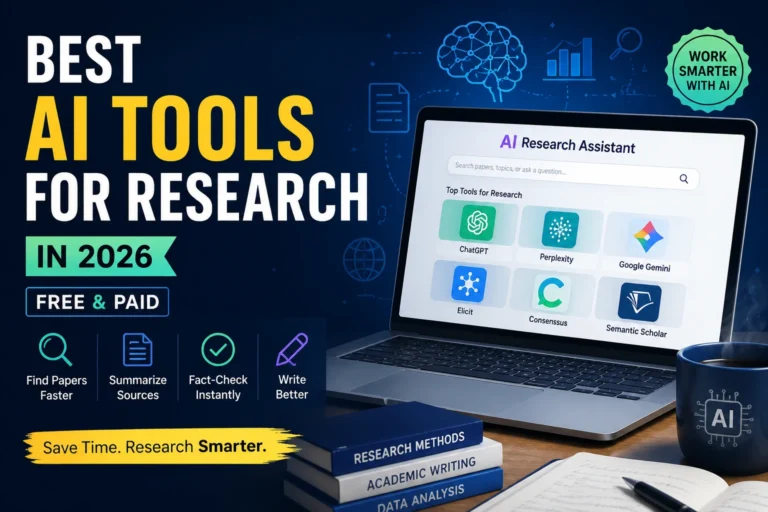
This guide covers the best AI tools for research in 2026 with real pricing, pros and cons, and honest comparisons so you can pick the right tool for your needs.
Why AI Tools Are Changing Research in 2026
AI-based research tools allow for quicker literature reviews, more thorough analysis, and better productivity when writing research papers. AI has become a complete partner in conducting research from conception to publication.
Whether you are a student writing a thesis, a blogger doing content research, or a professional analyst, the right AI tool gives you a serious edge in 2026.
Best AI Tools for Research in 2026
1. ChatGPT — Best for General Research and Writing
ChatGPT is the most widely used AI research tool in 2026. It handles everything from summarizing topics to writing full research drafts.
Free Plan: Yes — GPT-4o available free
Paid Plan: ChatGPT Go at $8/month, ChatGPT Plus at $20/month
Pros:
- Easy to use for beginners
- Great for writing, summarizing, and explaining complex topics
- Free plan is generous in 2026
- Supports image generation and voice mode on paid plans
Cons:
- Does not always cite sources automatically
- Free plan has usage limits during peak hours
- Not ideal for finding peer-reviewed academic papers
Best for: Writing support, brainstorming, summarizing research, and content creation.
2. Perplexity AI — Best for Real-Time Research with Sources
Perplexity is one of the fastest-growing AI research tools in 2026. Every answer comes with cited sources so you can verify information instantly.
Free Plan: Yes — unlimited basic searches
Paid Plan: Perplexity Pro at $20/month, Education plan at $10/month for students
Pros:
- Every answer includes source citations
- Real-time web search built in
- Free tier is one of the best no-cost AI experiences available in 2026
- Education plan available at $10/month for students
Cons:
- Deep Research limited to 20 queries per day on paid plan
- Not specialized for academic databases like Elicit
- Free plan limits Pro Search to 5 queries per day
Best for: Fact checking, current events research, quick research with cited sources.
3. Google Gemini — Best AI-Powered Search Tool
Google Gemini combines Google Search with AI to give you smart, sourced answers directly from the web.
Free Plan: Yes — free with Google account
Paid Plan: Google AI Pro at $19.99/month
Pros:
- Backed by Google’s full search index
- Best context window — 1M tokens on paid plan
- Free plan is very capable for everyday research
- Integrates with Google Docs, Drive, and Gmail
Cons:
- Less specialized for academic research
- Paid plan needed for advanced features
- Not as strong as Perplexity for cited web research
Best for: General research, AI-powered Google search, academic overviews.
4. Elicit — Best for Academic Research
Elicit gives you access to about 138 million pieces of scholarly literature drawn from databases such as Semantic Scholar, PubMed, and OpenAlex.
Free Plan: Yes — limited searches per month
Paid Plan: Plus and Pro plans available Elicit’s 2026 pricing is structured around credits for searches, summaries, and extractions
Pros:
- Access to 138M+ research papers
- Built specifically for academic research
- Structured extraction tables for literature reviews
- Pulls from trusted databases like PubMed and Semantic Scholar
Cons:
- Not great for general research or writing
- Free plan credit limits are low
- Learning curve for beginners
Best for: Literature reviews, finding peer-reviewed papers, academic research, thesis writing.
5. Consensus — Best for Evidence-Based Research
Choose Consensus if you want to know what peer-reviewed literature collectively says about a specific, falsifiable hypothesis.
Free Plan: Yes, basic searches free
Paid Plan: Premium plan available for unlimited searches
Pros:
- Gives evidence-weighted answers from scientific papers
- Great for yes/no research questions
- Pulls only from peer-reviewed literature
- Easy to use for non-researchers
Cons:
- Limited to scientific and academic topics
- Not suitable for general or creative research
- Free plan has daily search limits
Best for: Academic fact-checking, evidence-based research, scientific queries.
6. Semantic Scholar — Best Free Research Database
For broader discovery, citation tracking, and building a reading list, Semantic Scholar is more useful.
Free Plan: 100% free no paid plan needed
Paid Plan: None
Pros:
- Completely free with no limits
- Large academic database with citation tracking
- Great for building reading lists
- Trusted by researchers worldwide
Cons:
- No AI writing or summarizing features
- Just a database not an AI assistant
- Interface is basic compared to other tools
Best for: Finding papers, citation tracking, building academic reading lists.
Best AI Research Tools — Full Comparison Table 2026
| Tool | Best For | Free Plan | Paid Plan | Cites Sources | Academic Papers |
| ChatGPT | Writing & summarizing | ✅ Yes | $8–$20/mo | ⚠️ Sometimes | ❌ No |
| Perplexity AI | Real-time research | ✅ Yes | $10–$20/mo | ✅ Always | ⚠️ Limited |
| Google Gemini | AI-powered search | ✅ Yes | $19.99/mo | ✅ Yes | ❌ No |
| Elicit | Academic research | ✅ Limited | Credits-based | ✅ Yes | ✅ Yes |
| Consensus | Evidence-based answers | ✅ Limited | Premium plan | ✅ Yes | ✅ Yes |
| Semantic Scholar | Citation tracking | ✅ Free | ❌ None | ✅ Yes | ✅ Yes |
Free AI Tools for Research for Students
If you are a student on a budget, these are the best free AI research tools in 2026:
- Perplexity AI — free, cites sources, great for quick research. Education Pro plan available at $10/month for students
- Elicit — free tier with access to 138M+ research papers
- Consensus — free, evidence-based answers from peer-reviewed papers
- Semantic Scholar — 100% free research database
- ChatGPT free plan — best for writing and summarizing
Need to check your research paper word count? Use our free Word Counter tool instantly.
Is ChatGPT Better Than Google for Deep Research?
Pay for Perplexity if your week is full of research you have to trust and cite. Pay for ChatGPT if your week is full of things you have to make writing, code, and multi-step tasks.
In simple terms:
- ChatGPT wins for writing, summarizing, and creating content
- Google Gemini wins for real-time search and web-sourced answers
- Perplexity wins for research that needs cited, verified sources
Tips for Using AI Tools for Research
- Always verify AI-generated information with original sources
- Use Perplexity or Consensus when you need cited answers
- Use ChatGPT for summarizing and rewriting in simple language
- Use Elicit for finding academic papers
- Treat AI suggestions as starting points, not final answers the responsibility for accuracy rests with you.
Need to clean up your research text? Use our free Text Tools to remove spaces, convert text, and more.
Conclusion
In 2026, AI tools have completely changed how research is done. Whether you are a student, blogger, or professional, the right tool saves you hours every week.
Start with Perplexity AI for quick cited research, Elicit for academic papers, and ChatGPT for writing and summarizing.
Need free tools for your research workflow? Visit Multiple AI Tools for free word counters, text tools, and more.
FAQs
Which AI tool is best for research in 2026?
Perplexity AI and Elicit are the best for research in 2026. Perplexity gives real-time cited answers while Elicit specializes in academic paper discovery.
Can I use ChatGPT for research?
Yes. ChatGPT is great for summarizing topics, brainstorming, and writing drafts. Always verify its answers with original sources.
What is the best free AI tool for students?
Perplexity AI, Elicit, and Semantic Scholar are the best free AI tools for students in 2026. All offer free plans with academic research access.
Is Perplexity better than ChatGPT for research?
For research with cited sources, Perplexity is better. For writing and summarizing, ChatGPT is stronger. Most researchers use both.
Which AI tool is best for academic research?
Elicit and Consensus are the best for academic research. Both pull from peer-reviewed databases and give evidence-based answers.