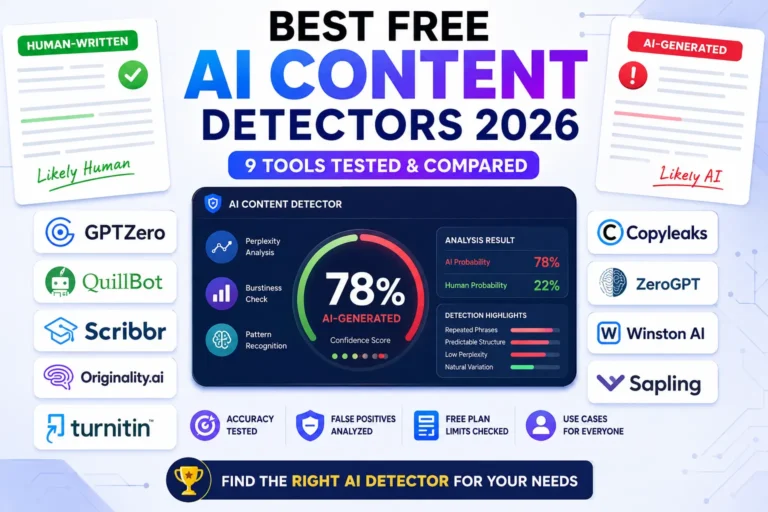
AI writing tools generate millions of words every single day. Teachers, editors, and content publishers now face one urgent question: is this text human or machine-made? Free AI content detectors promise an answer, but their accuracy varies wildly between tools.
We evaluated each AI detector using the same mix of human-written content, ChatGPT-generated text, Claude-generated text, lightly edited AI drafts, and heavily paraphrased AI content. We also compared false positives, free-plan limits, speed, ease of use, and overall consistency. Since AI detection models change frequently, these rankings reflect our latest review as of June 2026 and may evolve over time.
Last updated: June 2026. We recheck pricing and free-tier limits regularly since detector providers update them often.
How AI Content Detectors Actually Work
AI detectors analyze text for statistical patterns that separate machine writing from human writing. Two signals matter most: perplexity and burstiness.
Perplexity measures how predictable your word choices are. AI models pick high-probability words, so AI text often scores low on this measure. Human writing jumps between ideas and sentence lengths, creating natural unpredictability that detectors flag as authentic.
These tools remain triage instruments, not courtroom evidence. A flagged score should trigger a closer human review, never replace one. This matters even more for non-native English writers, technical content, and heavily edited drafts, where false positives spike.
Quick Comparison Table
| Tool | Best For | Free Limit | Accuracy | Verdict |
| GPTZero | Students/Teachers | 10,000 words/month | High | ✅ Editor’s Pick (Education) |
| QuillBot | All-round free use | Unlimited (basic scan) | High | ✅ Best Free Overall |
| Scribbr | Academic accuracy | Unlimited (basic scan) | Highest (free tier) | ✅ Most Accurate Free |
| Originality.ai | Publishers/Agencies | Limited trial | Highest (humanized text) | ✅ Best for Professionals |
| Turnitin | Institutions | Institution-only | High | ⚠️ Not for individuals |
| Copyleaks | Forensic audits | Very limited | High | ⚠️ Limited Free Tier |
| ZeroGPT | Quick unlimited checks | Unlimited | Moderate | ⚠️ Use with Caution |
| Winston AI | Editorial/WordPress | 2,000 words (14-day trial) | High | ⚠️ Trial, Not Truly Free |
| Sapling | Fast first-pass check | Limited | Moderate | ⚠️ Backup Tool Only |
Best Free AI Content Detectors in 2026
1. GPTZero — Best for Students and Educators ✅
GPTZero built its reputation in classrooms first. Princeton student Edward Tian created it specifically for academic settings, where a wrong accusation carries real consequences for a student’s record.
The free plan offers solid coverage, with the student tier scanning up to 10,000 words per month. GPTZero integrates directly with Google Classroom and Canvas, making it the natural pick for teachers managing multiple sections.
Pros
- Generous 10,000 words/month free limit
- Direct LMS integration (Google Classroom, Canvas)
- Trusted name in academic institutions
Cons
- Struggles with heavily paraphrased or humanized AI text
- Less reliable on non-ChatGPT models
Verdict: ✅ Best for Education
2. QuillBot AI Detector — Best All-Round Free Option ✅
QuillBot ties with Scribbr for the highest accuracy among completely free tools, correctly identifying AI text in independent testing at a consistently strong rate. It runs alongside QuillBot’s paraphrasing tool, so writers can check and rewrite flagged sections in one workflow.
Pros
- No account required for basic scans
- High accuracy on free tier
- Built-in paraphrasing tool for quick fixes
Cons
- Batch uploads locked behind Premium
- Slower on large documents
Verdict: ✅ Best Free Overall
3. Scribbr — Most Accurate Free Detector ✅
Scribbr’s free detector matched QuillBot for top accuracy in 2026 testing. Its premium version pushes even higher, identifying the largest share of AI text among every tool tested in independent comparisons.
Academic writers and thesis editors trust Scribbr because it publishes its detection methodology openly, unlike many competitors who keep their models opaque.
Pros
- Transparent, published methodology
- Highest free-tier accuracy in independent tests
- Citation generator included
Cons
- Premium needed for full-length documents
- Interface geared toward academic writing specifically
Verdict: ✅ Most Accurate Free Option
4. Originality.ai — Best for Publishers and Content Teams ✅
Originality.ai targets professional content workflows rather than casual checks. Multiple independent studies rank it as the most accurate detector for catching paraphrased and humanized AI content, a weak spot for most free tools.
Agencies managing freelance writers rely on Originality.ai to maintain content integrity at scale. If your content strategy depends on AI tools for writing SEO blog posts faster, pairing your workflow with a strong detector keeps your output original and defensible.
Pros
- Best accuracy against humanized/paraphrased text
- Built for team and agency workflows
- Combines plagiarism + AI detection
Cons
- No meaningful free tier, mostly paid
- Overkill for casual or one-off checks
Verdict: ✅ Best for Agencies (Paid-first)
5. Turnitin — Institutional Gold Standard ⚠️
Turnitin dominates higher education, with most universities running submissions through it by default. Its AI checker claims very high accuracy, though real-world false positive rates run higher than the marketing suggests.
Turnitin works best as one factor in a broader evaluation, not the final verdict on a student’s work.
Pros
- Most widely adopted institutional standard
- Strong long-term track record in academia
Cons
- Not accessible to individuals directly
- Real-world false positives of 2-5%
Verdict: ⚠️ Institution-Only Access
6. Copyleaks — Best for Detailed Forensic Analysis ⚠️
Copyleaks combines AI detection with plagiarism checking and provides the most detailed visual breakdown of flagged sections among the tools tested. Content auditors who need to justify a decision to a client or author prefer this level of transparency.
Pros
- Detailed sentence-level visual evidence
- Strong for plagiarism + AI combined audits
Cons
- Free tier very limited
- Among the most expensive paid plans
Verdict: ⚠️ Best Paid Option for Audits
7. ZeroGPT — Best for Unlimited Free Scans ⚠️
ZeroGPT offers unlimited free checks with no word cap, which explains its popularity among students on a budget. However, its accuracy lags behind QuillBot and Scribbr, and its false positive rate raises real concerns.
Treat ZeroGPT results as a first pass only, then verify flagged content with a second tool before acting on it.
Pros
- Truly unlimited free scans
- No sign-up required
Cons
- Higher false positive rate than top tools
- Inconsistent results on advanced AI models
Verdict: ⚠️ Use With Caution, Verify Elsewhere
8. Winston AI — Best for Editorial Workflows ⚠️
Winston AI integrates with WordPress and offers an API, making it a strong fit for publishers running detection checks directly inside their content management system. It also generates a certification badge that sites can display to verify human-written content.
Pros
- WordPress + API integration
- Issues a verifiable human-content certification
Cons
- “Free” tier is really a 14-day trial capped at 2,000 words
- Premium pricing higher than alternatives
Verdict: ⚠️ Trial, Not Truly Free
9. Sapling — Fast but Limited Accuracy ⚠️
Sapling delivers quick, free results, but its accuracy trails the top tools, particularly against text generated by newer AI models. Use it for a rapid first check, not a final decision.
Pros
- Fast results
- Simple, no-friction interface
Cons
- Lower accuracy on newer models (GPT-5, Claude, Gemini)
- Not reliable as a standalone decision-maker
Verdict: ⚠️ Backup Tool Only
Which Free AI Detector Should You Use?
Your choice depends entirely on your role and risk tolerance:
- Students: GPTZero or Scribbr for self-checking before submission
- Teachers and institutions: Turnitin, backed by a second tool for borderline cases
- Content publishers and agencies: Originality.ai for catching humanized AI text
- Quick casual checks: ZeroGPT, with results treated cautiously
- Detailed audits: Copyleaks for the visual evidence trail
If you’re producing content at scale and want to understand how detection affects your search rankings, our guide on whether AI content hurts or helps SEO in 2026 covers that connection in detail.
Can You Reduce False Positives?
Yes, partially. Adding personal anecdotes, varying your sentence length, and editing AI drafts manually all increase perplexity and lower detection risk. Running your draft through a paraphrasing tool before publishing also helps humanize stiff AI phrasing, though it won’t guarantee a clean score.
For writers who blend AI assistance with original input, our roundup of best free AI tools for content writing and blogging shows how to keep that balance without triggering detectors unnecessarily. You can also explore broader options in our best AI writing tools 2026 guide if you’re building out your full content stack.
Frequently Asked Questions
Are free AI detectors accurate?
Top free tools like QuillBot and Scribbr match or beat several paid competitors, but no detector reaches 100% accuracy.
Can free AI detectors catch humanized AI content?
Most struggle after heavy paraphrasing or editing, though Originality.ai performs best against humanized text.
Which AI detector has the lowest false positive rate?
QuillBot and Scribbr report the lowest false positive rates among free tools tested in 2026.
Is Turnitin’s AI detector accurate?
Turnitin claims very high accuracy, but independent testing shows real-world false positives between 2-5%.
Do AI detectors work on non-native English writing?
No, accuracy drops sharply for non-native English, technical writing, and very short text samples.
Can Google detect AI-generated content?
Google does not penalize content simply because AI helped write it. It evaluates content based on quality, originality, usefulness, and whether it satisfies the user’s search intent.
Conclusion
No single free AI detector gets it right every time. GPTZero and Scribbr lead for students and educators, Originality.ai wins for agencies handling paraphrased content, and ZeroGPT works only as a quick, unverified first pass. The safest approach combines two tools and pairs every flagged result with human judgment rather than treating any single score as final proof.
As detection models and AI writers both keep evolving through 2026, expect accuracy rankings to shift. Bookmark this page and check back, since we recheck and update these rankings as new tests come in.
Note: AI detection results can carry real consequences for students and writers. Always verify a flagged result with a second tool and human review before taking any academic or professional action.
About this guide: Compiled using publicly available accuracy studies, vendor documentation, and independent testing data from Scribbr, Originality.ai, Zapier, and academic integrity research published in 2026.